
arketplace insurance florida

Open Enrollment Period (OEP): Typically runs from November 1 through January 15 annual
The Open Enrollment Period (OEP) is an important time for individuals and families who want to enroll in or make changes to their health insurance coverage. During this period, eligible consumers can explore different health plans through the Health Insurance Marketplace and choose coverage that best fits their needs and budget.
Finding affordable health coverage can be easier when you understand the Health Insurance Marketplace. It allows eligible individuals and families to compare health insurance plans, review costs, and find out whether they qualify for financial assistance.
When choosing a health plan, it is also important to think about your everyday health habits. For example, many people ask, “what water should I drink in a day?” In general, plain drinking water is a healthy choice, and staying properly hydrated can support overall well-being.
The Health Insurance Marketplace can help you compare different plans based on premiums, deductibles, covered services, and other costs. You may also qualify for savings depending on your household income and circumstances.
Before selecting a plan, check whether your preferred doctors, hospitals, and medications are covered. Understanding these details can help you choose coverage that fits your needs and budget.
Whether you are enrolling for the first time or reviewing your current coverage, learning how the Health Insurance Marketplace works can make the process simpler and more manageable.
Sure. Here are 10 U.S. states and their official Health Insurance Marketplace names. These are state-based marketplaces listed by CMS for 2026. (Centers for Medicare & Medicaid Services)
| # | State | Health Insurance Marketplace |
|---|---|---|
| 1 | California | Covered California |
| 2 | Colorado | Connect for Health Colorado |
| 3 | Connecticut | Access Health CT |
| 4 | Maryland | Maryland Health Connection |
| 5 | Massachusetts | Massachusetts Health Connector |
| 6 | Minnesota | MNsure |
| 7 | New Jersey | Get Covered New Jersey |
| 8 | New York | NY State of Health |
| 9 | Pennsylvania | Pennie |
| 10 | Washington | Washington Healthplanfinder |
These marketplaces help residents compare health plans and, where eligible, apply for financial assistance.
OEP gives people the opportunity to apply for a new health insurance plan, renew their current coverage, or make changes to an existing Marketplace plan. For example, you may want to select a different plan because your healthcare needs, household size, preferred doctors, or budget have changed. Comparing available options can help you find a plan with suitable benefits and costs.
When choosing a health insurance plan, it is important to consider more than just the monthly premium. You may also want to review deductibles, copayments, prescription drug coverage, provider networks, and other benefits. Taking time to compare plans can help you make a more informed decision about your healthcare coverage.
The Open Enrollment Period is especially important because, in many cases, you cannot enroll in or change Marketplace coverage outside the enrollment window unless you qualify for a Special Enrollment Period (SEP). Certain life events, such as marriage, having a baby, or losing qualifying health coverage, may allow you to make changes outside of OEP.
Preparing early can make the enrollment process easier. Gather important information about your household, income, and current health coverage before reviewing your options. It is also helpful to check enrollment deadlines carefully, as dates can vary depending on the Marketplace or state.
In conclusion, the Open Enrollment Period is a valuable opportunity to review your health insurance needs and select coverage for the coming year. By comparing plans and understanding your options, you can choose coverage that provides greater confidence and peace of mind.
December 15 Deadline: The final day to enroll or change plans if you need your coverage to begin on January 1.
When navigating the Florida Health Insurance Marketplace (via HealthCare.gov), timing is everything. While the annual Open Enrollment Period gives Floridians a chance to secure or update their healthcare coverage, one specific date stands above the rest: December 15.
Coverage Starts January 1 To ensure your health insurance is active on New Year’s Day (January 1), you must select a plan and complete your enrollment by December 15. Missing this target means your coverage won’t take effect until later, leaving you with a risky, uninsured gap at the start of the year.
Health Insurance Marketplace Login?
To log in to your Health Insurance Marketplace account, visit the official HealthCare.gov website and select “Log in.” You can use your account to manage your application, review coverage, and make changes to your plan.
Health Insurance Marketplace PA?
Pennsylvania’s official health insurance marketplace is Pennie, where residents can compare health plans and apply for financial assistance.
Health Insurance Marketplace NY?
New York’s official marketplace is NY State of Health, where residents can compare plans and apply for coverage.
Health Insurance Marketplace Number?
The Health Insurance Marketplace number is 1-800-318-2596 for help with Marketplace coverage and applications.
Can I access my 1095-A form online?
Yes. You can access your 1095-A online by logging into your Marketplace account, selecting the appropriate application year, then choosing “Tax Forms” → “Download PDF.” (healthcare.gov)
Key Dates to Remember
- November 1: Open Enrollment officially begins.
- December 15: Deadline to enroll for coverage effective January 1.
- January 15: Final end of the standard Open Enrollment window (enrolling after Dec 15 delays coverage to Feb 1).
Why You Shouldn’t Wait
- Avoid Gaps in Care: Enrolling by December 15 ensures continuous coverage for ongoing prescriptions, doctor visits, and unexpected medical needs as soon as the year begins.
- Maximize Savings: Enrolling early gives you ample time to report accurate income estimates and evaluate eligible premium tax credits, which significantly lower your monthly payments.
- Beat the Rush: System traffic on HealthCare.gov peaks during the final days of Open Enrollment. Completing your application early avoids long virtual wait times.
If you miss the final enrollment window completely, you won’t be able to buy Marketplace insurance unless you qualify for a Special Enrollment Period due to a major life event like moving, getting married, or losing existing coverage.
Take control of your health today—log onto HealthCare.gov before December 15 to pick the best plan for your family and secure full-year peace of mind!
Unlocking Health Insurance Year-Round: The Special Enrollment Period

While the annual Open Enrollment Period is the standard time to sign up for health insurance, life doesn’t always wait for a specific date on the calendar. A Special Enrollment Period (SEP) allows individuals and families to secure or change coverage outside the regular enrollment window.
What Triggers a Special Enrollment Period? To qualify for an SEP, you must experience a recognized Qualifying Life Event (QLE). These major life changes open a brief window for you to select a new health plan:
- Loss of Prior Coverage: Involuntarily losing job-based insurance, aging off a parent’s plan at 26, or losing Medicaid eligibility.
- Household Changes: Getting married, having or adopting a baby, or navigating a divorce that affects coverage.
- Relocation: Moving to a new zip code or county—including moving to or within Florida—that offers different health plan options.
- Income Shifts: Experiencing income changes that make you newly eligible for lower monthly premiums through tax credits.
The 60-Day Countdown In most cases, you have 60 days from the date of your qualifying event to pick a plan and submit proof, such as a marriage certificate or official termination letter. Missing this 60-day window usually means waiting until the next annual Open Enrollment window.
If you’ve recently gone through a major life change, check HealthCare.gov immediately to submit your documentation and ensure your family stays protected!
Plan Tiers in Marketplace Insurance Florida
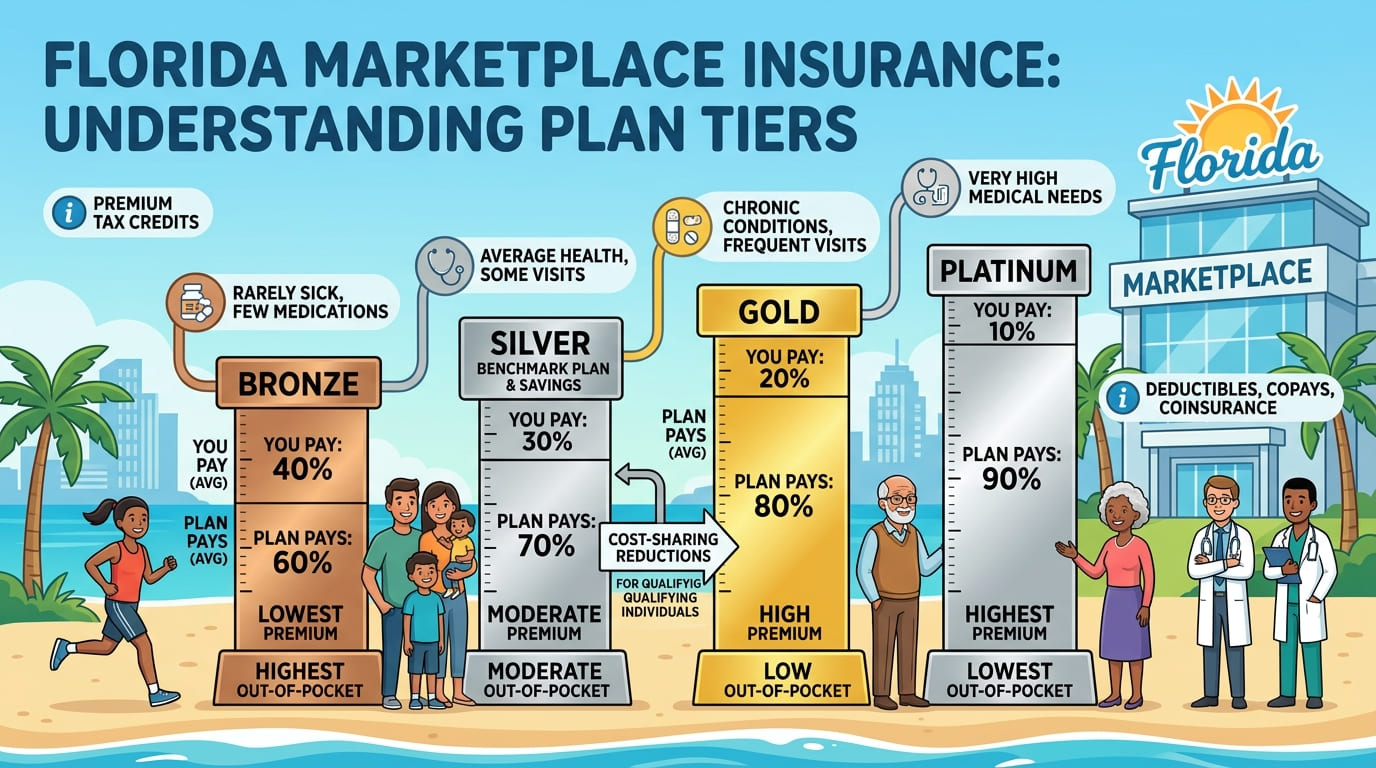
the different plan tiers available. Health insurance Marketplace plans are generally organized into four metal categories: Bronze, Silver, Gold, and Platinum. These categories help you compare how you and your insurance plan may share healthcare costs.
Bronze plans usually have lower monthly premiums but higher out-of-pocket costs when you receive medical care. These plans may be a good option for people who want affordable monthly payments and do not expect to need frequent healthcare services.
Silver plans offer a balance between monthly premiums and out-of-pocket costs. They are a popular choice for many individuals and families. Depending on eligibility and income, some Marketplace consumers may also qualify for additional savings that can reduce certain out-of-pocket expenses with a Silver plan.
Gold plans generally have higher monthly premiums but lower costs when you receive covered medical care. This option may work well for people who visit doctors regularly, take prescription medications, or expect ongoing healthcare expenses.
Platinum plans usually have the highest monthly premiums but lower out-of-pocket costs for covered services. These plans can be useful for individuals who expect to use healthcare services frequently.
When comparing Marketplace Insurance Florida plans, do not choose a plan based only on the monthly premium. Consider the deductible, copayments, coinsurance, provider network, prescription drug coverage, and maximum out-of-pocket costs. The right plan tier depends on your budget, healthcare needs, and how often you expect to receive medical care.
By understanding Bronze, Silver, Gold, and Platinum plan tiers, Florida residents can compare their options more confidently and choose Marketplace coverage that better fits their individual or family needs.
Unlocking Health Insurance Year-Round: The Special Enrollment Period
For millions of Americans, applying for health insurance used to be an overwhelming process, especially for those managing chronic medical issues. Prior to major health care reform, an existing diagnosis could lead to denied coverage, exorbitant monthly premiums, or policy exclusions that left critical treatments unpaid.
Today, fundamental safeguards protect consumers from these financial and medical penalties.
What Counts as a Pre-Existing Condition? A pre-existing condition is any physical or mental health issue diagnosed or treated before new health insurance coverage begins. This applies to a wide spectrum of medical situations, including:
- Chronic Illnesses: Conditions like diabetes, asthma, hypertension, or heart disease.
- Severe Diagnoses: Cancer, autoimmune disorders, or kidney disease.
- Mental Health: Depression, anxiety, or bipolar disorder.
- Pregnancy: Being pregnant prior to enrolling in a new plan cannot be treated as a disqualifying health condition.
How the Law Protects You Under Affordable Care Act (ACA)-compliant guidelines, health insurance companies are legally prohibited from penalizing you based on your health history:
- Guaranteed Issue: Insurance providers cannot refuse to sell you a policy or deny enrollment based on pre-existing conditions.
- Equal Pricing: Insurers cannot charge higher rates or impose surcharge penalties based on individual health status or medical history. Premium costs rely solely on age, geographic location, tobacco use, household size, and the chosen plan tier.
- Immediate Benefits: Coverage for pre-existing conditions starts on day one of your policy—with no mandatory waiting periods or temporary exclusions for necessary treatments.
Exceptions to Keep in Mind While ACA-compliant Marketplace plans, Medicare, Medicaid, and standard employer-sponsored insurance fully protect pre-existing conditions, not all health coverage follow these rules:
- Short-Term Health Plans: Temporary insurance policies often evaluate medical history and can reject applications or exclude pre-existing conditions from coverage.
- Grandfathered Plans: Certain individual policies purchased before March 2010 may still carry exemptions from standard consumer protections.
Choosing an ACA-compliant plan through the Health Insurance Marketplace ensures you receive comprehensive essential care without facing penalties for prior health challenges.