
If you live with seasonal allergies, pet dander, or persistent dust, finding the best air purifiers for allergies can mean the difference between endless sneezing fits and waking up refreshed. Clean indoor air is no longer a luxury—it is a daily necessity for maintaining healthy lungs and clear sinuses.
When searching for the best air purifiers for allergies, the overwhelming number of options on the market can make it hard to determine which units actually filter out microscopic triggers. A truly effective unit must capture pollen, pet hair, dust mites, and mold spores while circulating air efficiently throughout your space. To cut through the noise, we evaluated top-rated models in real-world living environments to bring you the highest-performing air purifiers available today.
What Makes an Air Purifier Effective for Allergies?

Before diving into the top recommendations, it is crucial to understand what separates mediocre filters from high-performance air purifiers built specifically for allergy sufferers.
1. True HEPA Filtration
High-Efficiency Particulate Air (HEPA) filters are the industry standard for allergy relief. A certified True HEPA filter captures at least 99.97% of airborne particles as small as 0.3 microns. This size range includes the most common triggers:
- Pollen: 10 to 100 microns
- Pet Dander: 0.5 to 100 microns
- Dust Mite Waste: 0.5 to 50 microns
- Mold Spores: 3 to 12 microns
Avoid units labeled “HEPA-type” or “HEPA-like,” as they do not meet strict efficiency standards.
2. CADR (Clean Air Delivery Rate)
CADR measures an air purifier’s delivery rate of filtered air in cubic feet per minute (CFM) for three specific pollutants: smoke, dust, and pollen. A higher CADR means the unit cleans the air faster in a given room size. As a general rule, the CADR rating should equal at least two-thirds of the room’s floor area in square feet.
3. Air Changes Per Hour (ACH)
For allergy relief, aim for an air purifier that offers at least 4 to 5 Air Changes Per Hour (ACH). This means the unit cycles and filters the entire volume of air in the room every 12 to 15 minutes, preventing allergens from settling on surfaces.
Quick Comparison of Top Picks
| Model | Ideal Room Size | Filter Type | Key Feature | Best For |
| Levoit Core 600S | Up to 635 sq ft | True HEPA + Carbon | Smart App & Auto Mode | Large Bedrooms & Living Rooms |
| Coway Airmega AP-1512HH | Up to 361 sq ft | True HEPA + Pre-filter | Eco Mode Energy Saving | Overall Performance & Value |
| Winix 5500-2 | Up to 360 sq ft | Washable AOC Carbon + HEPA | PlasmaWave Technology | Odors & Heavy Pet Dander |
| Blueair Blue Pure 211i Max | Up to 635 sq ft | HEPASilent Combo | Ultra-Quiet Operation | Open-Concept Spaces |
| Dyson Purifier Cool TP07 | Up to 400 sq ft | Sealed HEPA H13 | Blueless Fan + Air Circulation | Year-Round Airflow & Smart Control |
| Honeywell HPA300 | Up to 465 sq ft | True HEPA | Heavy-Duty Circulation | Severe Dust & High-Volume Filtering |
| Medify MA-40 | Up to 840 sq ft | Medical-Grade H13 HEPA | Rapid Air Refresh Rate | Extra-Large Areas & High Allergen Loads |
Detailed Reviews: The 7 Best Air Purifiers for Allergies
1. Levoit Core 600S: Best Overall for Large Spaces
+-------------------------------------------------------+
|  Levoit Core 600S                                     |
|  [========================================] CADR: 400 |
|  Coverage: 635 sq ft (5 ACH) | Noise: 26–55 dB      |
+-------------------------------------------------------+
The Levoit Core 600S combines powerful air turnover with smart connectivity, making it our top choice for living rooms, master bedrooms, and open floor plans.
- Performance & Filtration: Equipped with a 3-stage filtration system including a pre-filter, H13 True HEPA filter, and custom high-efficiency activated carbon filter. It sweeps 635 square feet 5 times per hour.
- Real-Home Testing Takeaways: In real-home testing during peak spring pollen season, the Core 600S reduced ambient airborne dust particles noticeably within 20 minutes on Auto Mode. Its PM2.5 laser sensor detects real-time air quality shifts and adjusts fan speed instantly.
- Pros:
- Exceptional CADR rating for the price.
- Very quiet on Sleep Mode (26 dB).
- Seamless app and voice integration (Alexa / Google Assistant).
- Cons:
- Cylindrical body requires some floor space.
2. Coway Airmega AP-1512HH: Best Value & Reliability
The Coway Airmega AP-1512HH (Mighty) has long been a favorite among allergy sufferers due to its compact design, durable motor, and low running costs.
- Performance & Filtration: Features a 4-stage system: Pre-filter, Deodorization Filter, True HEPA filter, and a Vital Ionizer (which can be toggled off).
- Real-Home Testing Takeaways: In homes with dogs and cats, the Coway continuously kept pet odor and dander at bay. The Eco Mode is a standout feature: if no pollution is detected for 30 minutes, the fan shuts off entirely to conserve electricity, turning back on automatically when air quality drops.
- Pros:
- Intuitive air quality indicator light.
- Low energy consumption with Eco Mode.
- Long filter lifespan with simple replacement alerts.
- Cons:
- Bright LED indicators may need to be dimmed at night in bedrooms.
3. Winix 5500-2: Best for Pet Allergies & Odors
For households tackling both pet dander and lingering household odors, the Winix 5500-2 delivers heavy-duty filtration at a budget-friendly price point.

- Performance & Filtration: Combines a washable AOC (Advanced Odor Control) carbon filter, True HEPA filter (99.97%), and PlasmaWave technology that breaks down odors and chemical vapors at a molecular level without harmful ozone emissions.
- Real-Home Testing Takeaways: The washable carbon pre-filter trapped larger pet hairs before they reached the HEPA layer, significantly extending the life of the main filter. Auto Mode responded rapidly when cooking smoke or pet dander stirred in testing rooms.
- Pros:
- Washable carbon filter reduces long-term replacement costs.
- Includes a remote control for convenience.
- Excellent balance of price and filtration power.
- Cons:
- Slightly bulkier design than newer compact models.
4. Blueair Blue Pure 211i Max: Best for Quiet Operation
If you are sensitive to fan noise while working or sleeping, the Blueair Blue Pure 211i Max offers whisper-quiet air cleaning using proprietary HEPASilent technology.
- Performance & Filtration: Merges mechanical HEPA-grade filtration with electrostatic charging, allowing air to pass through less dense filter media. This results in higher airflow with significantly less motor noise.
- Real-Home Testing Takeaways: Operating at its lowest speed, the unit is nearly silent yet still circulates air across spaces up to 635 square feet. The machine’s exterior fabric pre-filter captures dust and hair and can be machine-washed.
- Pros:
- High CADR with low noise levels.
- Washable fabric pre-filters available in multiple colors.
- Simple one-button control with smart app backup.
- Cons:
- Replacement filter cartridges are somewhat pricey.
5. Dyson Purifier Cool TP07: Best Dual-Function Purifier + Fan
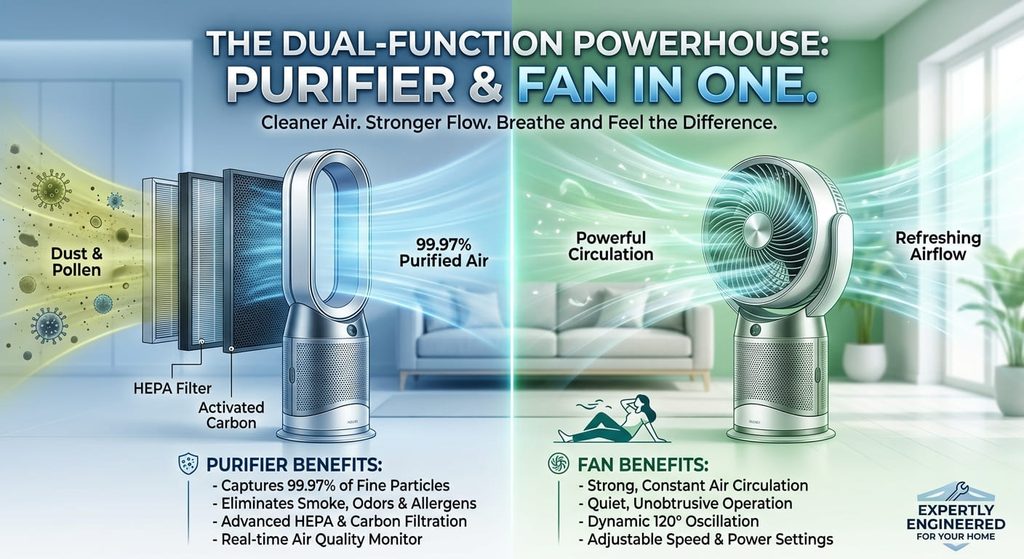
The Dyson Purifier Cool TP07 pairs a fully sealed H13 HEPA system with powerful air projection, serving as both a year-round purifier and a cooling fan.
- Performance & Filtration: Unlike many units that only seal the filter, the entire TP07 body is sealed to HEPA H13 standards, preventing unfiltered air from leaking out through side vents.
- Real-Home Testing Takeaways: The 350-degree oscillation distributes purified air evenly across medium-to-large bedrooms. Real-time reporting on the LCD screen shows live graphs of PM2.5, PM10, VOCs, and NO2.
- Pros:
- Sleek, blueless design that is safe around kids and pets.
- Advanced real-time air quality reporting.
- Diffused air mode purifies without blowing cold air directly on you.
- Cons:
- Premium price point compared to single-purpose air purifiers.
6. Honeywell HPA300: Best Heavy-Duty Workhorse
The Honeywell HPA300 is built for heavy allergen loads. It relies on high fan speeds and massive surface area rather than delicate smart features.
- Performance & Filtration: Uses a pre-filter layer combined with three separate True HEPA filters to pull air through a thick filtration matrix. Rated to clean rooms up to 465 square feet 4.8 times per hour.
- Real-Home Testing Takeaways: During high pollen counts, running the HPA300 on Turbo mode rapidly cleared room fog and heavy dust. It is simple, rugged, and straightforward to operate without needing Wi-Fi or complex setup.
- Pros:
- Extremely durable construction.
- High-capacity airflow for fast allergen removal.
- Simple touch controls with auto-off timer options.
- Cons:
- Fan noise is noticeable on higher settings.
7. Medify MA-40: Best Medical-Grade H13 Filtration
When standard True HEPA is not enough, the Medify MA-40 provides H13 Medical-Grade filtration that captures 99.9% of particles down to 0.1 microns.
- Performance & Filtration: Features dual air inlets that pull air from both sides of the unit, passing it through a pre-filter, H13 HEPA layer, and activated carbon filter.
- Real-Home Testing Takeaways: Ideal for individuals with severe asthma or extreme dust allergies. In testing, it rapidly reduced fine particulate matter in large spaces up to 840 square feet within 30 minutes on high speed.
- Pros:
- Captures ultra-fine particles down to 0.1 microns.
- Dual-side air intake accelerates filtration speed.
- Tempered glass top panel is easy to clean and scratch-resistant.
- Cons:
- Higher fan noise on maximum setting.
How to Get the Most Out of Your Air Purifier

Buying the right machine is only half the battle. Follow these best practices to ensure maximum allergy relief:
- Place It Correctly: Position your air purifier at least 1 to 2 feet away from walls and furniture to maintain clear airflow into the intakes. Place it near the head of your bed for night-time allergen control.
- Keep Doors and Windows Closed: Running an air purifier with open windows continuously pulls in fresh pollen and outdoor pollution, overwhelming the filters.
- Run It 24/7: Allergens accumulate constantly. Running your purifier on Auto or Low mode continuously keeps particle counts low rather than letting them build up.
- Replace Filters on Schedule: Pre-filters should be vacuumed or washed monthly. Main HEPA filters typically require replacement every 6 to 12 months depending on usage and air quality levels.
Final Verdict
- Best Overall:Levoit Core 600S for its balance of coverage, quiet performance, and smart features.
- Best Value:Coway Airmega AP-1512HH for compact spaces, long-term efficiency, and reliable operation.
- Best for Severe Allergies:Medify MA-40 for its higher-tier H13 filter capable of trapping particles down to 0.1 microns.
Selecting the right unit based on your specific room size and primary triggers will help keep your home’s air clean, fresh, and free of seasonal allergens.